

Withering Into the Truth
That’s what those wrinkles are all about…

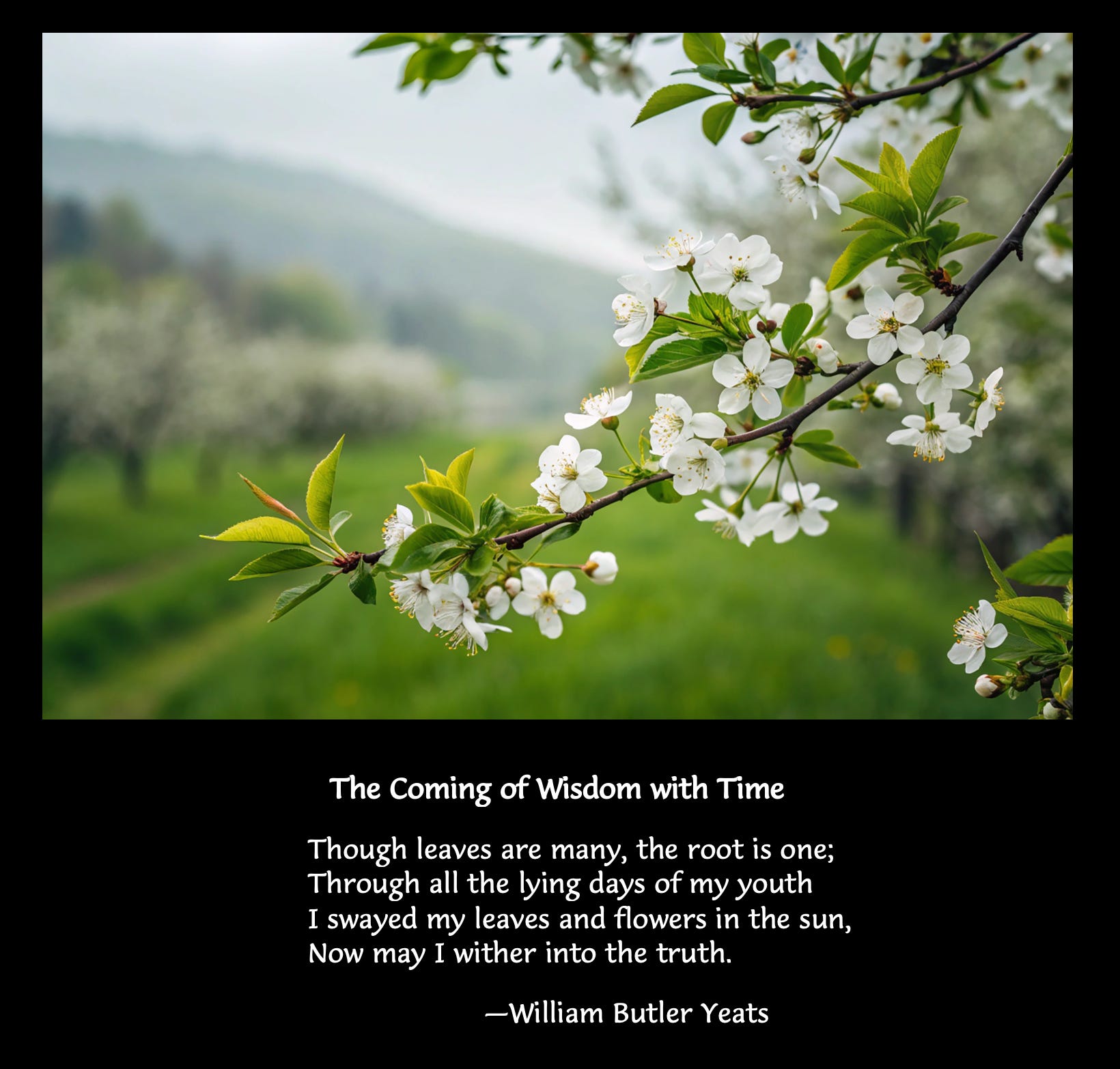
I. Clearly, wisdom requires more than the passage of time. The octogenarian president of the U.S. is Exhibit A: the black hole where his heart should be is where wisdom goes to die. So it wasn’t the title that drew me to this little classic by William Butler Yeats. Instead, I recognized myself in his lines about “the lying days of my youth” and the chance age gives me to “wither into the truth.”
For the most part, my youthful “lies” weren’t intentional. I just didn’t know enough about myself and the world to tell the truth. So my commentary on those subjects back in the day was blissfully unburdened by experience, reflection, self-critique or common sense. Nonetheless, that notorious liar called the ego compelled me to carry on as if I knew what I was talking about.
I recently ran across a 200-page manuscript I wrote and submitted for publication in my mid-twenties. With it was what must be one of the kindest rejection letters ever written. After offering me a thoughtful critique, the editor of a major publishing house said, “You clearly have some good ideas. Someday you may well write a book we can publish. So keep learning, keep writing, and don’t get discouraged by the fact that we can’t publish this one. This is how you get better at what you want to do.”
As I reread that letter, I thanked the fates for an editor who might well have said, “This is the kind of writing that gives typing a bad name.” Worse still, he might have published a book so wrong-headed it would have knee-capped my chance to be taken seriously as a writer. Instead, he gave me a prod that resulted in my first book, fifteen years later.
II. Coming to terms with the soul-truth of who I am—with my complex and confusing mix of self-confidence and self-delusion—has required my ego to shrivel up. And nothing has shriveled me better than age. That’s what the wrinkles are all about.
That process does not happen automatically, which is why the poem takes the form of a petition: “may I wither into the truth.” Withering requires us to allow the masks we wear to fall away, revealing our true face. As they fall, we have a chance to get closer and closer to “the root” of who we really are, what we really know and what we have to say. It all depends on us not trying to Botox the wrinkles away.
It’s interesting to me that one of the most important poems I’ve ever written—important, that is, to my wellbeing—a poem that helped me survive a deep dive into depression, contains a line about my face:
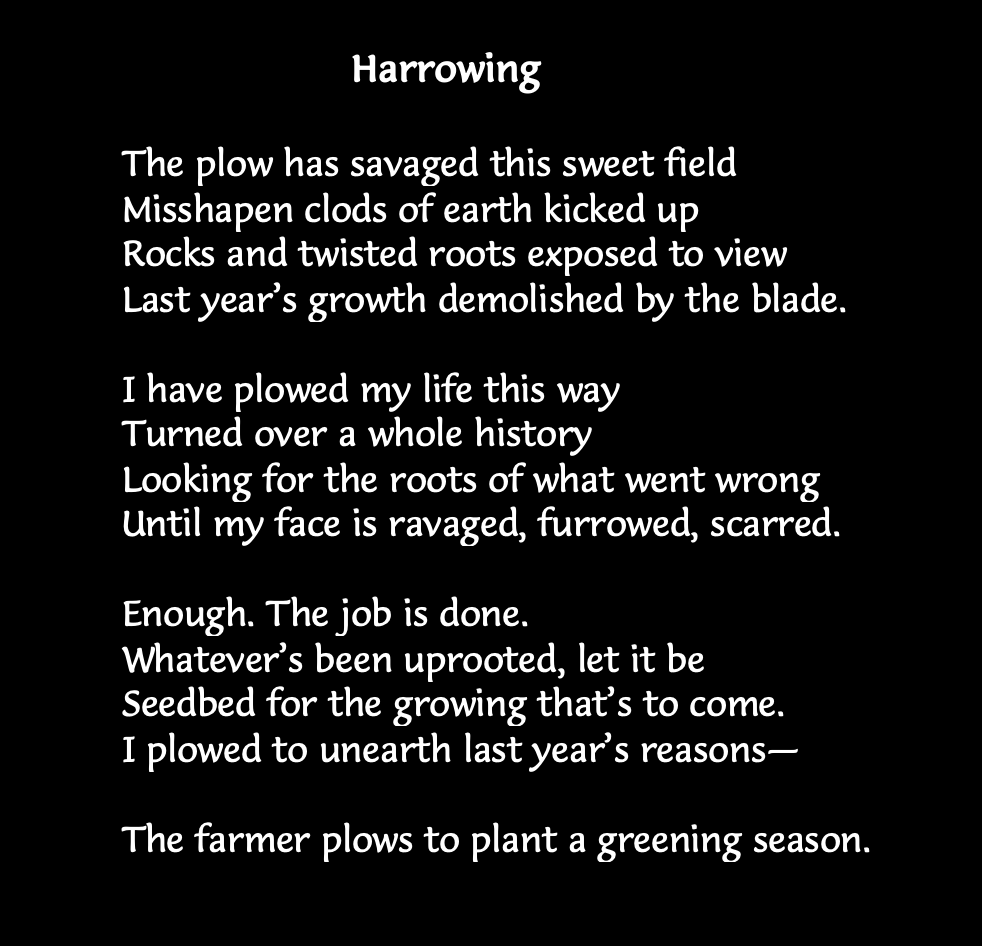
I didn’t describe my face as “ravaged, furrowed, scarred” in hopes of making an impact on the reader. I wrote those words because they were true to what I saw in the mirror after a long agony, and to the metaphor of the plowed field. I wrote it because something in me knew that all of that “withering” was the result of falsehood falling away, a composting of the soul that helps the seeds of new life take root and grow.
Whatever truthfulness I’ve achieved on this score comes not from spiritual practice or the courage to face myself honestly. It comes from having my ego so shattered that I had no choice but to cry uncle and say, “OK, I get it. I’m far from perfect.” This is the opportunity of our elder years—if we actively embrace them and the withering they bring.
III. At age 87, I’ve written millions of words and more than a few very long sentences. But perhaps the most important sentence I’ve ever written is in the third stanza of “Harrowing.” It’s that one word, “Enough.” Said on the right occasion, that word can safeguard the soul, and saying it comes more easily with age.
When I was young, it often seemed risky to say “enough.” It’s possible to lose favor, friends, reputation and one’s livelihood for saying, “This far and no further.” But risk looks different from the vantage of old age. I no longer fear the cost of taking risks for things I care about. Instead, I fear succumbing to the temptation to hide out and let the world pass by, to die before I die.
Age has given me more courage to say “enough” to anything that’s not life-giving—whether it’s frenzy and overwork, a long-held grudge, an unhealthy relationship, a societal cruelty or injustice, the feckless exercise of power in fields from religion to politics, or the racism, sexism, xenophobia and borderline fascism currently sickening the U.S. body politic.
I’m among the privileged elders who still have relatively good health and don’t have to worry about losing the basics required for survival. For people like me, the notion that old age is a time to dial it down and play it safe is a cop-out. Those of us who are able should be raising hell on behalf of whatever we care about. To paraphrase Kris Kristofferson, old is just another word for nothing left to lose.
IV. Most older folks I know fret about unloading the material goods they’ve collected over the years, stuff that was once useful to them but now needs to be jettisoned lest their families be left with a Herculean task. I know this from personal experience. There are precincts in our basement where a small child could get lost for days.
But the junk I really need to jettison in my old age is psychological junk, such as longtime convictions about what gives my life meaning that no longer serve me well. For example, who will I be when I can no longer do the writing that has been a primary source of identity for me for the past half century?
I won’t know the answer until I get there. But on my way to that day, I’ve found a question that’s already brought me a new sense of meaning. I no longer ask, “What do I want to let go of, and what do I want to hang on to?” Instead I ask, “What do I want to let go of, and what do I want to give myself to?”
The desire to “hang on” comes from a sense of scarcity and fear. The desire to “give myself” comes from a sense of abundance and generosity. That’s the kind of truth I want to wither into.
V. Sooner or later, “withering into truth” ends in death, the ultimate form of withering. Is it also the ultimate source of truth? Who knows? Maybe death will be as the great Lucille Clifton imagines it in her remarkable poem about her husband’s death when everything finally become clear to him:
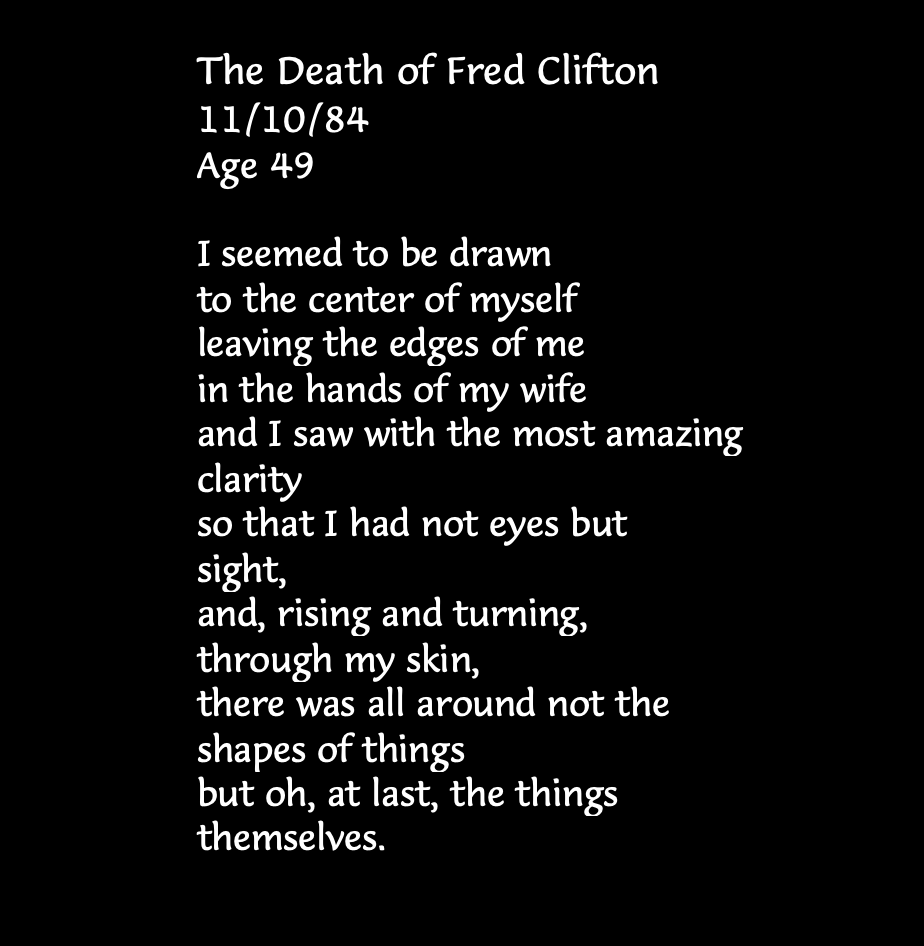
I have no idea what, if anything, I will learn from dying. But this I know for sure: I have no bad memories of where I came from when I was born, so I have no good reason to fear where I’m going when I die. Besides, I know exactly where I’m going: to the Boundary Waters Canoe Area along the Minnesota-Ontario border (48°N, 91°W), a wild and holy place where I spent summer’s end every year for twenty-five years. Whenever I was there, I thought, “This is heaven.” All that’s left is to figure out how to bring a canoe along.
I may not have heaven’s latitude and longitude exactly right. But one way or another, we’re all going to end up in Mother Nature’s arms as our atoms recombine with the stuff from which they came. When I’m in need of the comfort that comes from that undeniable fact, all I need to do is to take another walk in the woods, a hike into the mountains, a stroll alongside the ocean, or a trek in the desert, where all the withering eventually ends in new life. Such ineffable beauty, such surpassing grace!
P.S. If you enjoy my Friday essays, you might enjoy my 2018 book, On the Brink of Everything: Grace, Gravity and Getting Old. A Revised and Updated 2026 Edition will come out in September. With a re-publication like this, pre-orders really help a book along. If you’d like to place one, please click HERE, then on the bookseller of your choice. Thanks!
• “Parker J. Palmer is one of our wisest minds and lives and one of my greatest mentors. There is no one I’d rather eavesdrop on as he ponders ‘the brink of everything.’” —KRISTA TIPPETT (founder of On Being Studios, author of Becoming Wise)
• “Parker J. Palmer is the most integral and wholehearted teacher of our age. Here is a deep reflection on aging that offers a master’s earned view of the large and the small and how we’re all vital threads woven together by life. It will stir your soul and bring you closer to everything.” —MARK NEPO (author of The Book of Awakening)
• “Parker J. Palmer has been a mentor and midwife to countless young people in my generation, including me. My greatest aspiration is to journey through life and arrive at the brink as Parker has, with humility and faithfulness, and pockets full of gems.” —VALARIE KAUR (author of See No Stranger)
[NOTES: My 10 books are HERE and HERE. The Center for Courage & Renewal is HERE. I post on Substack every Friday, as time and energy allow. Free as well as paid subscriptions will always have access to everything I post.]
Oh my god!
Can you please not die?
Every week i am astounded by the way your words reach so deeply into my soul
You are a treasure, Parker J. Palmer. I've been aware of you through the years, through your writing(s). It was the liminal title of your Substack that beckoned me. With each post, I have a deepening sense that I wasn't ready for you til I came to this point in my life. Though I haven't had quite as many turns around the sun, I find comfort and joy in each offering. When Friday comes and I see the email announcing your presence, I breathe a little easier. Thank you for being an incredible model for how life can look as we age. I look to you as a revered generous, loving spirit-embodied-human mentor. I thank you 💞