


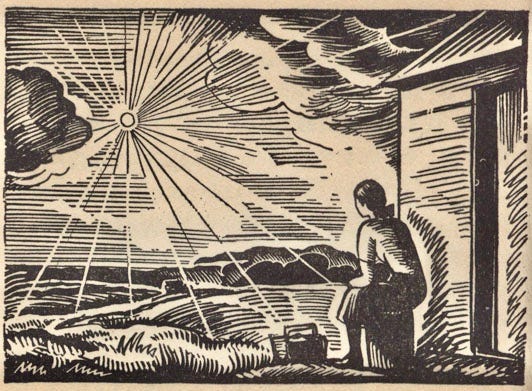
I. The Buddhist monk Thích Nhất Hanh once had an onstage dialogue with psychiatrist and theologian Jerry May, a dearly departed friend of mine. A large audience had gathered in Washington, D.C. to hear these two good men talk about paths to peace in our world and our hearts.
In mid-dialogue, Nhất Hanh began reciting a phrase he often used in his teaching: “Every moment, perfect moment. Every moment, perfect moment.” He meant, of course, that if you can fully inhabit the present moment—the only moment you have—you’ll be fully alive.
But Jerry—animated by who knows what—was not having it, at least not in that moment! With a grin on his face, he leaned toward his good friend Nhất Hanh and said, “But Thích, old buddy, some moments suck!” The crowd exploded in laughter, and no one laughed harder than the Buddhist monk.
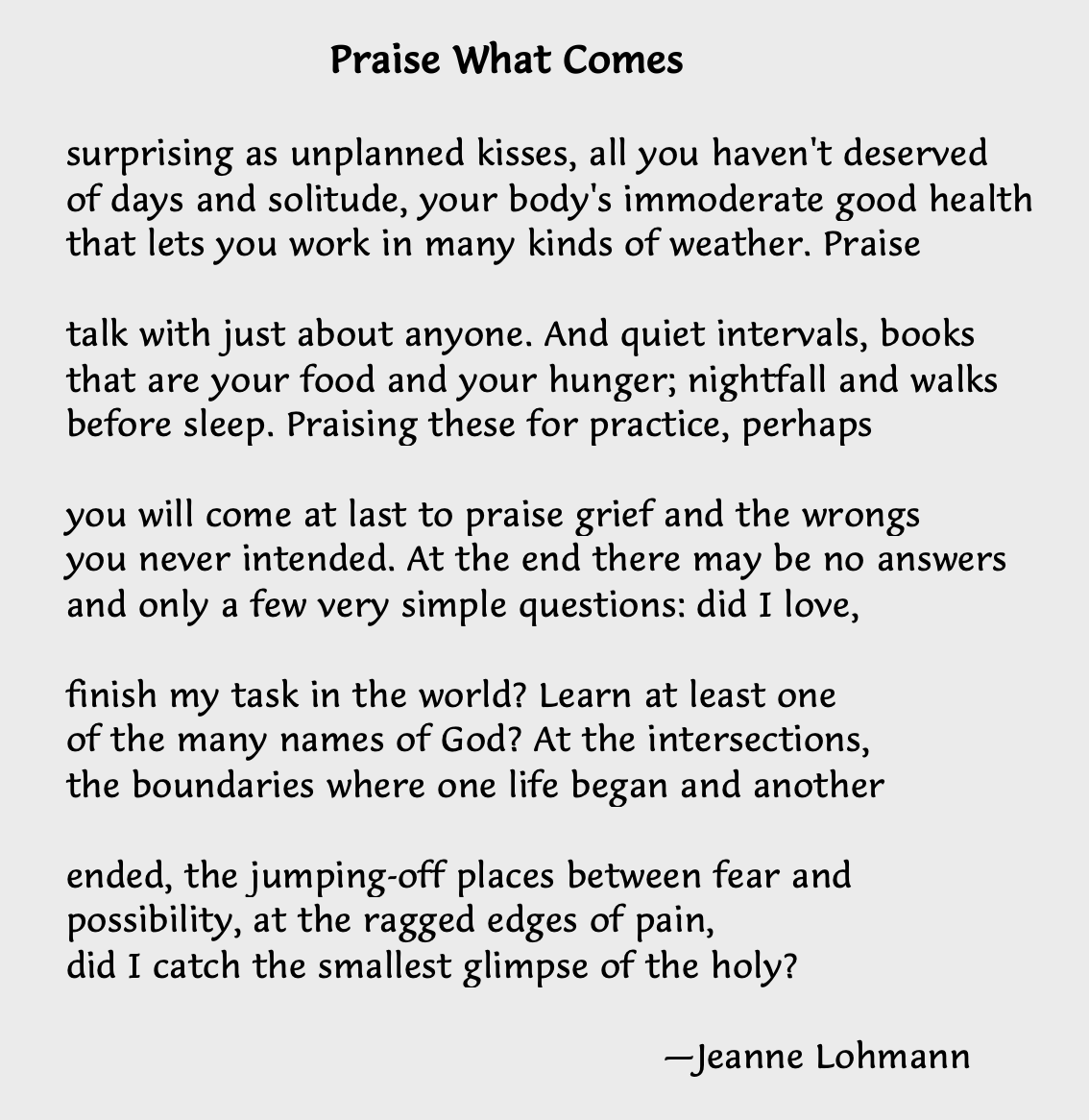
II. The first time I read Jeanne Lohmann’s “Praise What Comes,” I had my own Jerry May moment.
“Really, Jeanne? Praise everything that comes my way? Does that include the walls I slam into and the holes I fall into? How about the worldly slings and arrows from which I sometimes suffer? And how about the country I love sliding into fascism while millions cheer? I’ll praise stuff like that as soon as Satan sends a memo telling me to bring ice skates along when I get summoned to Hell!”
Fortunately, I learned a long time ago that when I push back hard on well-intended guidance, it might just be a sign that it’s guidance I need. And having been one of Jeanne Lohmann’s pen pals in her elder years (she died in 2016 at 93), I knew that she always wrote honestly about the adventure of being human.
So I re-read the poem with the mindfulness Thích Nhất Hanh taught, and soon found three points at which the poem opened up for me—and I opened up to the poem. Ever since, “Praise What Comes” has been a trustworthy companion on my journey.
III. The first opening came with that long list of easy-to-praise experiences, from unplanned kisses to the ability to spend time outdoors, from good books and conversation to solitude and silence. What kind of person would not praise things like these, the simple, everyday blessings that come our way?
Well, I’m that kind of person more often than I’d like to admit. It’s not that I don’t enjoy those moments. I always have. But I’m more likely to give energy to cursing moments of pain than I am to praising moments of blessing.
The result is predictable. When I give insults, injuries and my own screwups too much attention, the story I tell myself about my life is that of a man full of self-pity who thinks he deserves better. Then I become Donnie Downer, a guy even I don’t like hanging out with.
All of that changes when we have the sense to shut down the grievance factory—lookin’ at you, POTUS and MAGA—and not only enjoy but praise all the large and small ways we are daily blessed. At my age, the ability to wake up and greet another day is a praiseworthy event, and praising such small blessings as the warm greeting of a passing stranger is a way of living fully into the moment.
IV. The second opening I found in the poem came with these lines: “Praising these [blessings] for practice, perhaps / you will come at last to praise grief and the wrongs / you never intended.”
Doesn’t it always boil down to this: practice, practice, practice! Then perhaps you might learn to play the piano, or baseball, or learn to praise the hard things in life. There is no guarantee that the practice of “praising what comes” in bad as well as good times will take you to bliss. But the path of resentment is guaranteed to lead to misery for you and those closest to you.
How can one praise those moments in life, small and large, that knock us down and lay us low? For me, the answer hinges on whether I’m able to learn something about myself in those moments, something that will help me negotiate the next one with a little more grace.
As everyone in their 80s knows, this is a decade when grief becomes a fellow traveler as people you’ve loved take their leave, one after another. But in the middle of our losses, it’s always possible to find something to praise if we can turn our grief into active appreciation for the gift of life in ourselves and others. As we do, we might come up with good answers to the questions Jeanne Lohmann asks at the end of her poem.
V. Those questions are the third point at which “Praise What Comes” opened up for me. Instead of ending her poem with a lesson in morality, Jeanne Lohmann asks some of the most evocative questions I know: “Did I love, / finish my task in the world? Learn at least one / of the many names of God?”
These are open questions, probing questions, humble questions, all worth pondering—with the understanding that coming up with answers is not the point. The point is to allow questions like these to draw us toward reflecting more deeply and living more deeply while we have the gift of life.
My favorite question of those the poem poses is this: At moments when life takes me to “the jumping-off places between fear and / possibility, at the ragged edges of pain, / did I catch the smallest glimpse of the holy?” I think back to my three experiences of clinical depression, in each of which I often wondered if it was time to check out. But somehow, some way, a tiny flicker of life remained that, with help, I was able to fan into a fire, a holy fire of new life.
Wendell Berry wrote, “There are no unsacred places; / there are only sacred places / and desecrated places.” The midterm elections give us a chance to put the wisdom of Berry and Lohmann into political action. Instead of merely cursing the path of desecration the U.S. is on, let’s vote to create a country that is truly worthy of praise.
P.S. “Praise What Comes” is from Jeanne Lohmann, The Light of Invisible Bodies: Poems (Daniel & Daniel Publishing, 2003). You can listen to Jeanne read her poem HERE.
P.P.S. If you’ve read my book On the Brink of Everything, please consider leaving a brief review of the just-released 2026 edition wherever you buy books. New editions need all the help they can get, and reviews help a lot. Thanks!
[NOTES: My 10 books are available wherever you get your books, including HERE and HERE. The Center for Courage & Renewal is HERE. I post on Substack every Friday, as time and energy allow. Free as well as paid subscribers will always have access to everything I post.]
I am a man in my late seventies, definitely a Donnie Downer for most of it, more like Eeyore than Winnie or Tigger, but actually grateful for that small glimpse of the holy I was given thirty years ago when I surrendered my alcoholism to my Higher Power and found the mystery of grace to continue one day at a time.
Thank you for this, Parker. Every time you post, I read and am thankful. You help recalibrate me in these sometimes listless, sometimes raging days.