


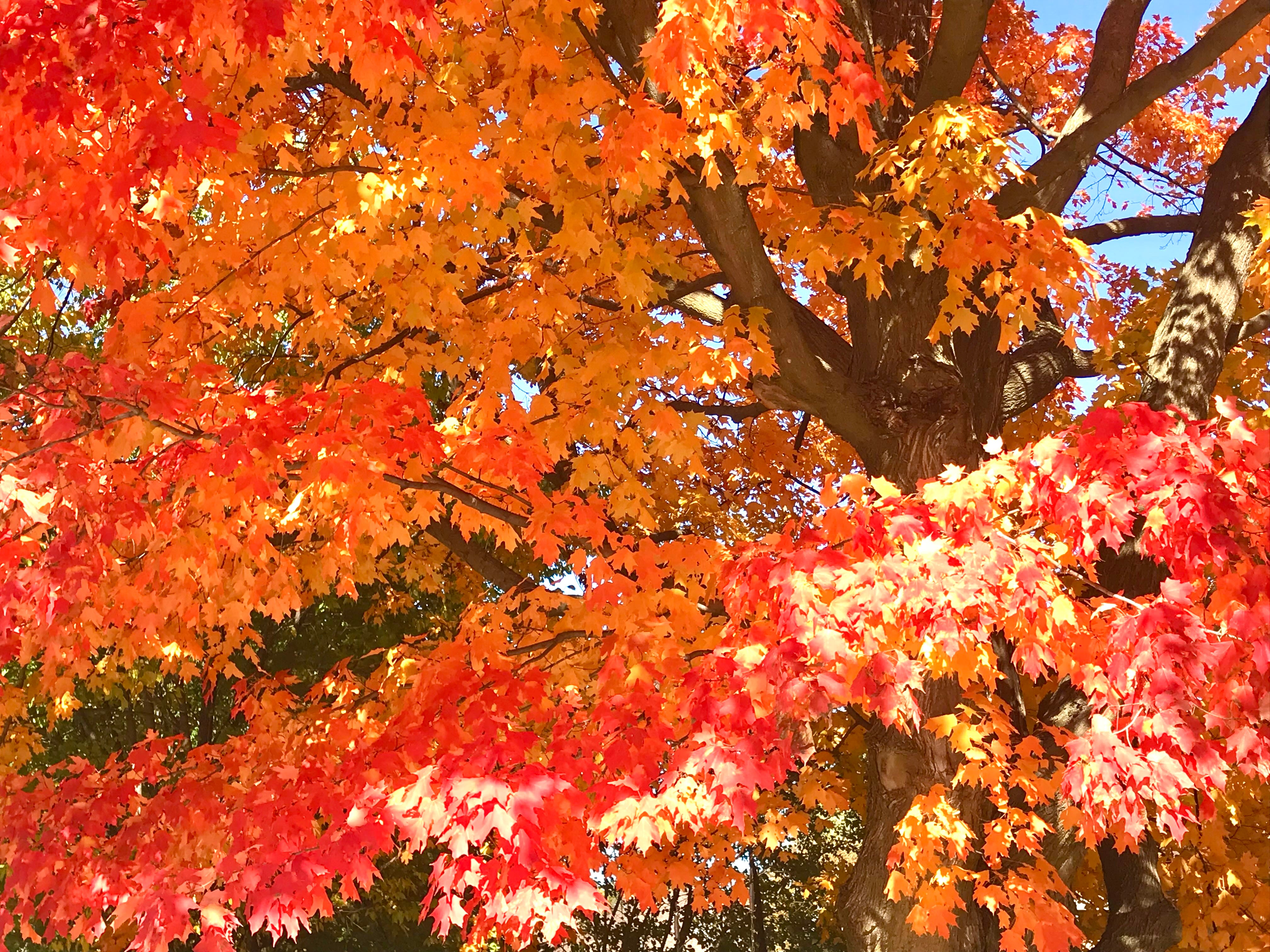
[Because of MAGA’s bottomless arrogance, greed and cruelty, 42 million Americans will spend November without the support of SNAP (the Supplemental Nutrition Assistance Program). Of those who will suffer from insufficient food, 40% are children, 20% are adults with disabilities, and most of the rest are among the working poor. Please give as generously as you can to food banks or food pantries in your area (find one HERE). As Autumn demonstrates, Mother Nature does not allow darkness and death to have the last word, but is forever making all things new. Let’s follow her lead in creating a world where being human means helping each other live in the light of love, truth and justice…]
I. “Autumn is a second spring when every leaf is a flower,” wrote Camus. It’s also a season of decline and, for some of us, deepening melancholy. The leaves in their glory are gone too soon. The days grow shorter and colder. Summer’s abundance begins to decay toward a wintry death.
I’m a professional melancholic, and for years my delight in autumn’s palette slipped into sadness as I watched the beauty die. Focused on the decline and fall of summer’s green growth, I allowed the prospect of death to eclipse all that’s life-giving about autumn and its sensuous delights.
Then I began to understand a simple fact: all the “falling” out there is full of promise. Seeds are being planted and leaves composted as earth prepares for yet another uprising of green.
Today, at age 86, as I experience the late autumn of my own life, I find nature a trustworthy guide. I’m not apart from nature, I’m a part of it—and the renewal that’s happening “out there” is also happening “in here,” if I have eyes to see it.
II. As time whistles us down, it’s easy to fixate on how our lives are going to ground. Work we’ve done well is forgotten, our sense of meaning and purpose dims, people we’ve loved and depended on die.
But when I’m able to see how life “composts” and “seeds” us just as surely as autumn composts and seeds the earth, I’m better able to see how possibility gets planted in and through me even as things fall away.
Looking back, I see how often my losses laid the ground for new life. The job I got fired from opened me to look for work that was mine to do, the “road closed” sign turned me toward terrain I’m glad I traveled, failures that felt irredeemable forced me to find new sources of meaning.
In each of these experiences, it felt like something was dying, and so it was. And yet amid all the dying, silently the seeds of new life were being sown: all I needed to do was pay attention to them.
III. If that’s the way my life has worked in the past, why would it be any different now, as that part of life called death comes into view?
That’s the lens through which I read “Autumn” by Rainer Maria Rilke, a master at mapping out life’s subtle ethers. For three stanzas, he chronicles life’s endless fallings—but his final line is an “and yet.” Falling is not the end of the story, he says. There is a presence in our midst that quietly upholds us even as we fall.
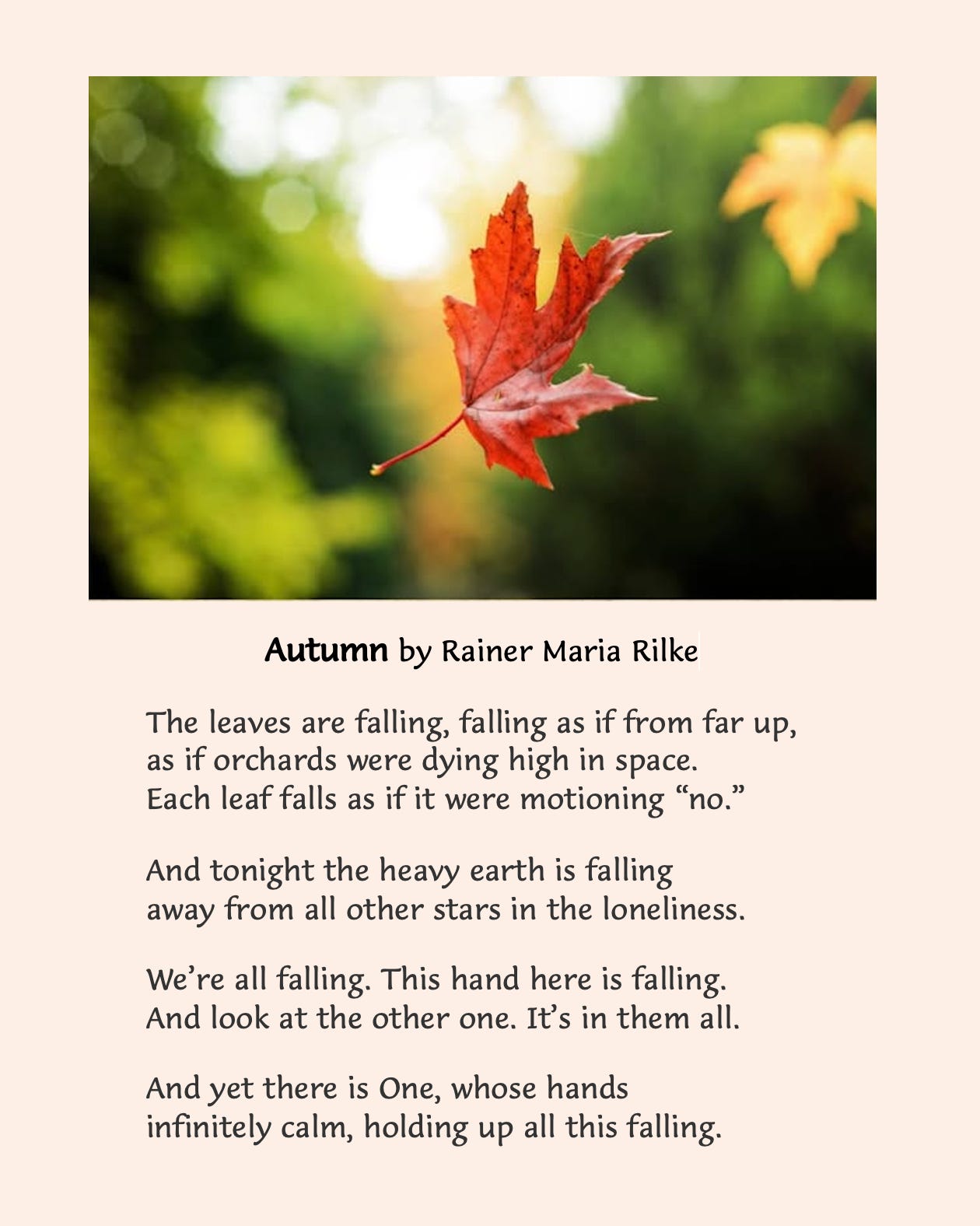
Some will dismiss Rilke’s words as nothing more than wishful thinking, but I cannot. They square with my most profound experiences of being upheld in the web of life. I think, for example, of a solo hike I made thirty-five years ago in the high desert of New Mexico, when I spent the better part of a day without seeing or hearing anything human other than my own body and breath.
Suddenly, in one of those instants that somehow transcends time, I knew two things to be true. On one hand, the cosmos is utterly indifferent to me, and why not? I’m no more than a grain of sand in the grand scheme of things. On the other hand, the cosmos embraces and welcomes me as a part of life’s vast and glorious whole. It felt as if my life, your life, all life is upheld with something akin to unconditional love.
IV. Far from feeling like a contradiction, those two truths—indifference and acceptance—feel like flip sides of the coin to me.
In that moment in the high desert, I knew no fear of death. Instead, it seemed clear that death would weave me more deeply into the tapestry of life that has been my home all along, just as all this autumn dying is reweaving the earth’s elements into yet another season of green growth.
We live in a culture of either/or that does not know how to hold opposites as both/and. We want light without darkness, the glories of spring and summer without the demands of autumn and winter, the pleasures of life without the pangs of death. If we hope to move beyond binaries into the land of both/and, the life-and-death paradox of autumn can help us along.
The words of Thomas Merton, monk and mystic, have helped me understand this paradox: “There is in all visible things…a hidden wholeness.” Apparent opposites like falling and rising, darkness and light, death and life go hand-in-hand. They need each other for wholeness, just our bodies depend on breathing in and breathing out.
V. When we so fear the dark that we demand light around the clock, the result is predictable: artificial light that is glaring and graceless and, beyond its borders, a darkness that grows ever more terrifying as we try to hold it off. We’ve filled the earth with city lights that keep us from seeing the stars, and our lives with glowing screens that keep us from seeing each other, so it is no surprise that we so often live in fear.
But when we yield to the hidden wholeness—to the endless interplay of all that falls and all that rises—the life we are given is as real and colorful, fruitful and whole as this graced and graceful world and the eternal cycles that make it so.
I still grieve as beauty goes to ground—but in the same breath, I praise the primal power that is forever making all things new in me, in us, and in the vast tapestry of darkness and light that is our home.

[NOTES: My 10 books are HERE and HERE. The Center for Courage & Renewal is HERE. I post on Substack every Friday, as time and energy allow. Free as well as paid subscriptions will always have access to everything I post.]
I am awed by the fact that every paragraph holds a profundity. Your gift of writing with clarity and density amaze me.
A life lesson for those of us in our autumn years. I have always marveled at the crepe myrtle tree in my front yard. Every year, the blossoms die, fall to the ground, we prune it, and then next spring tiny buds begin to show ever so slowly. Then the branches start to grow, and by summer, it is in full bloom again. That has been the metaphor for my life for a long time. I give thanks for this tree that reminds me of new birth in all creation